

Microgravity is now being used for various life science experiments, including crystallization and cell culture.
Take inspiration from past cases and realize your ideas in space.
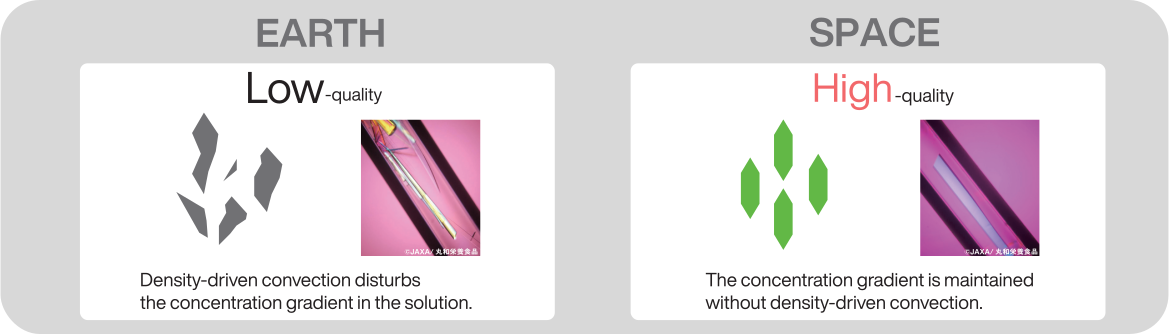
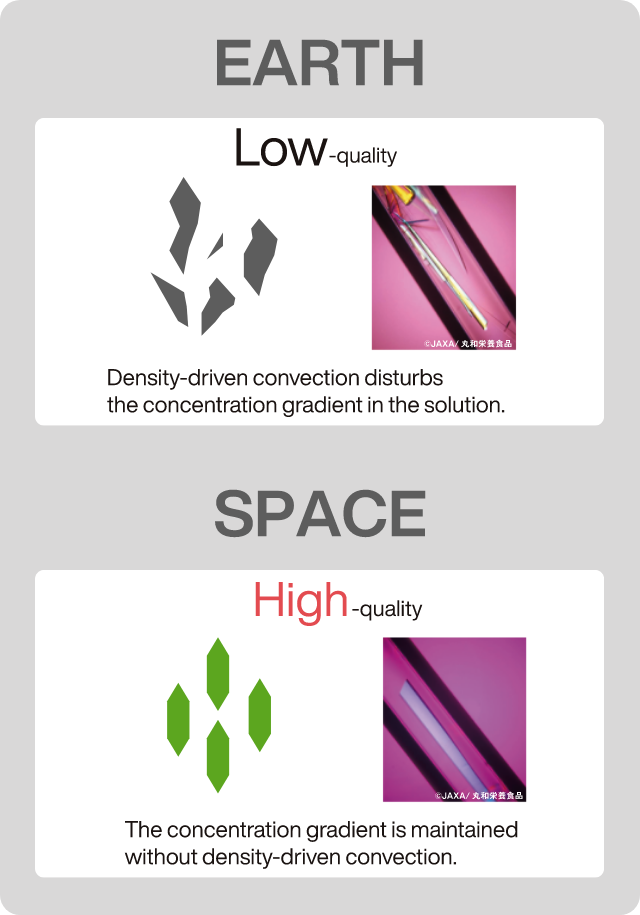
On Earth, density-driven convection occurs during crystal growth, causing rapid changes in concentration around the crystal nucleus. This disturbs molecular alignment and often results in small or poorly defined crystals.
In microgravity, the nonexistence of convection and sedimentation allows a stable concentration gradient during crystal growth. This stable environment enables us to yield high-quality crystals for high-resolution structural information.

Advancing the Understanding of Disease Mechanisms
On Earth, cells adapt their morphology and functions in response to mechanical stimuli from gravity. A loss of gravitational stress triggers cytoskeletal remodeling, and changes in gene expression, cell proliferation, differentiation, and metabolic functions. Researching these cellular changes is expected to provide novel insights into the mechanisms of disease and cellular aging.

Ideal Environments for 3D Tissue Modeling
Cells cultured in a microgravity environment naturally aggregate into three-dimensional structures, which are thought to closely resemble their state within the human body. Consequently, this environment is expected to become a novel tool for building complex cell structures and gaining a more accurate understanding of intercellular communication and cellular responses.

Accelerating Cancer and Aging Research
In space, exposure to stressors such as microgravity and radiation often accelerates cellular aging and cancer progression significantly faster than on Earth. By utilizing space as an "accelerated aging platform," it may be possible to shorten the timeline for constructing disease models. Ultimately, this is expected to speed up the efficacy evaluation of drugs under development.
In this case, the research team conducted crystallization experiments in space to explore the optimal crystallization conditions required for drug formulation.
- Why Utilizing Space?
Subcutaneous (SC) formulations are more beneficial for patients and healthcare providers than intravenous (IV) formulations, as they can minimize hospital visits and optimize storage requirements. To obtain high-resolution crystals for a better understanding of protein structures – essential for developing SC formulations of monoclonal antibody - crystallization experiments were conducted in space.
- Results from Space Experiments
Through crystallization in International Space Station, researchers identified the conditions for producing crystal suspensions with uniform and monodisperse particles size distribution at high yields. The findings from space experiments were integrated into ground-based manufacturing process, leading to the development and production of innovative subcutaneous formulation.
- Project Overview
At the time, researchers could not obtain protein crystals which meet expectations in terms of resolution and size on Earth. Based on hypothesis that microgravity environment would enable protein crystals to grow larger and higher resolution, they decided to conduct crystallization experiments in the ISS.
Following three rounds of experiments in space, they identified the optimal conditions for producing high-yield crystalline suspensions with a monodisperse particles size distribution. Furthermore, they found that these space-grown samples were less viscous and sedimented more uniformly. These findings were applied to the manufacturing on Earth and led the successful production of crystalline suspensions optimized for injectable formulations.
Reference: NPJ Microgravity. 2019 Dec 2;5:28. doi: 10.1038/s41526-019-0090-3
In this case, the research team cultured brain organoids in space to investigate the impact of microgravity on cellular differentiation and maturation.
- Why Utilizing Space?
The immune system is believed to be involved in the pathology of multiple sclerosis and Parkinson’s disease. However, the underlying causes remain unknown. In particular, understanding the behavior of microglia – the immune cells of the brain – is key to elucidating these pathologies. Since cells are affected by gravitational stimuli, the team expected to find new insights into mechanisms of these diseases through researching cellular changes in microgravity.
- Results from Space Experiments
In this research, cortical and dopaminergic organoids were cultured in the ISS. The team found a decrease in gene expression associated with cell proliferation and an increase in expression related to cell maturation. These findings suggest that cell maturation may be accelerated in the space environment.
- Project Overview
Previous research suggests that microgravity may influence vestibular and cognitive functions. Based on these insights, the team investigated the effects of microgravity on neural cells.
Organoids derived from patient-specific iPS cells were sent to the ISS and cultured for 30 days. The space-grown organoids showed a decrease in markers associated with neural cell differentiation and an increase in those related to cell maturation. These results suggest that the microgravity environment may accelerate the differentiation of neural progenitor cells.
Reference: Stem Cells Translational Medicine, Volume 13, Issue 12, December 2024, Pages 1186–1197
In this case, the research team utilized the microgravity environment - cells naturally aggregate into three-dimensional structures - to reveal cancer progression mechanisms.
- Why Utilizing Space?
To understand the mechanisms of cancer formation and proliferation, it is essential to observe cells in three-dimensional conditions, similar to those in the human body. 3D cell culture is often easier in microgravity since cells naturally aggregate into 3D structures. Leveraging this advantage of space, the research team investigated the mechanisms of cancer progression.
- Results from Space Experiments
Analysis of cancer cells cultured on the ISS revealed that the intracellular environment plays a key role in cancer growth, along with protein-related factors that regulate it. Based on insights from this experiment, the team developed a small-molecule drug that binds to a specific target, and R&D for clinical application is currently underway.
- Project Overview
In this project, breast and prostate cancer cells were sent to the ISS and cultured for one week. The team analyzed these space-cultured cells and identified the intracellular environment and factors associated with the proteins that regulate them. They also revealed that these intracellular regulators play a crucial role in cancer cell survival, metastasis and drug resistance. Insights from this experiment are being applied to the development of a new cancer drug, and the team is moving forward with the R&D for clinical use.
Reference: Oncogene 44, 494–512 (2025)
Feel free to contact us with any inquiries.